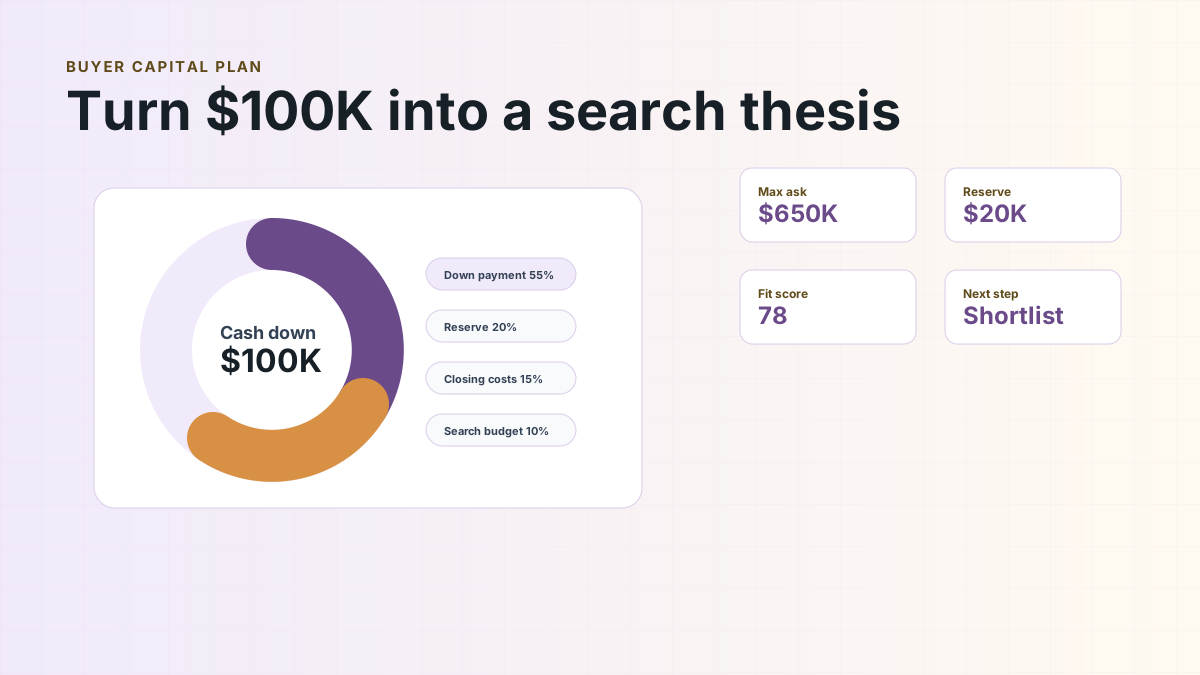
The best business to buy with $100k down is not a universal category. It is the business where your cash, financing structure, operating ability, and local market all fit at the same time. A buyer with $100k can still overreach if the deal needs a large working-capital reserve, immediate equipment replacement, or a heavy seller transition.
Treat $100k as a constraint to design around. Some of it may go toward buyer injection. Some may need to remain outside the purchase for closing costs, payroll timing, inventory, repairs, professional fees, and personal reserves. The mistake is spending the entire amount on down payment and calling the deal affordable. SCORE guidance on buying an existing business is a useful reminder that the purchase process includes diligence, valuation, financing, and transition work beyond the headline price.
In his review of this article, Adam Hoeksema described seeing lenders seek roughly 10% down plus a similar amount of post-close personal liquidity. That is his market observation, not an SBA-wide reserve rule. Ask prospective lenders for their own requirements before using it to set your budget.
$100k down is a constraint, not a strategy
Start with cash that must remain after closing. A $100,000 buyer who retains $50,000 personally has at most $50,000 available for injection and any costs that cannot be financed. Eligible closing costs and working capital may be included in total project uses, subject to lender approval; do not count financed costs again as an extra cash payment.
Start with the financing math
Before picking an industry, model the acquisition stack. Estimate purchase price, verified SDE, buyer cash injection, seller note, senior debt, working capital, closing costs, and buyer salary. Then ask whether the cash flow can support debt service with a margin of safety. SBA 7(a) financing can support eligible acquisition uses, but the business and borrower still have to underwrite.
With $50,000 available for a 10% injection, the arithmetic supports a $500,000 total project before any additional unfinanced costs. A $100,000 injection supports $1 million only if reserves and other cash needs are separately funded. Total project cost already includes the eligible closing and working-capital uses included in the financing request.
Also decide what kind of risk your $100k is supposed to absorb. If it is the only liquidity you have, you are not just budgeting a down payment; you are budgeting closing costs, professional advice, transition mistakes, and the first uncomfortable month after the seller steps away.
$100k buyer cash allocation screen
The same cash balance can support very different searches depending on reserves.
| Cash use | Aggressive plan | More conservative plan |
|---|---|---|
| Buyer injection | $100,000 | $55,000 |
| Closing/professional costs | $0 reserved | $15,000 reserved |
| Working capital | $0 reserved | $20,000 reserved |
| Personal/emergency reserve | $0 reserved | $10,000 reserved |
| Main risk | Undercapitalized after closing. | May need a smaller deal or more seller financing. |
What $100,000 can support after reserves
Three transparent cash budgets
| Use or constraint | All cash into injection | Half retained | Extra unfinanced costs |
|---|---|---|---|
| Starting buyer cash | $100,000 | $100,000 | $100,000 |
| Personal reserve retained | $0 | $50,000 | $50,000 |
| Unfinanced closing/diligence costs | $0 | $0 | $10,000 |
| Available injection | $100,000 | $50,000 | $40,000 |
| Project at 10% injection | $1,000,000 | $500,000 | $400,000 |
A $500,000 project could comprise $450,000 purchase price, $30,000 opening working capital and $20,000 eligible costs. With $50,000 injection and no seller note, bank principal is $450,000. At an illustrative 9.5% over ten years, annual payments are $69,875. A 1.25x coverage screen needs $87,343 of accepted cash flow, before separately reviewing household needs.
For a target producing $100,000 in accepted cash flow, those payments leave about $30,125 before personal withdrawals, tax and incremental capex. A buyer needing $60,000 for living expenses cannot treat the bank's coverage pass as proof of affordability.
Compare a route service collecting at completion with a B2B firm invoicing monthly on net-60 terms. At $12,000 biweekly payroll, four payroll runs require $48,000 before collections arrive. Customer deposits, receivables transfers and a working-capital facility can change that requirement; the business category name cannot.
Business types that may fit the screen
With limited cash, buyers often need lower-capex categories, clear financial records, and operations that can survive transition. Service businesses with recurring customers may fit better than storefronts that require expensive equipment or buildout. But even a good category can be a bad fit if the local market is saturated or the owner is irreplaceable.
Asset-light does not mean working-capital-light. A B2B service firm collecting invoices in 60 days may need two payroll cycles or more funded before cash arrives. Compare collection terms, payroll frequency, inventory and customer deposits before choosing a category.
Category fit for a $100k-down buyer
Use this to decide what deserves research, not as a ranking of guaranteed opportunities.
| Category | Why it can fit | Main diligence risk |
|---|---|---|
| Route or home services | Often asset-light and easier to understand. | Technician dependence, customer concentration, and owner sales role. |
| Small laundromats | Recurring demand and tangible assets. | Machine age, lease control, and utility exposure. |
| Small B2B services | May have repeat revenue and modest inventory. | Customer concentration and seller relationship transfer. |
| Specialty local retail | Can be understandable and locally defensible. | Inventory, lease risk, and demand changes. |
| Car wash or equipment-heavy deals | Can be attractive in the right market. | Capex, environmental, lease/real estate, and maintenance risk. |
Use market fit before calling brokers
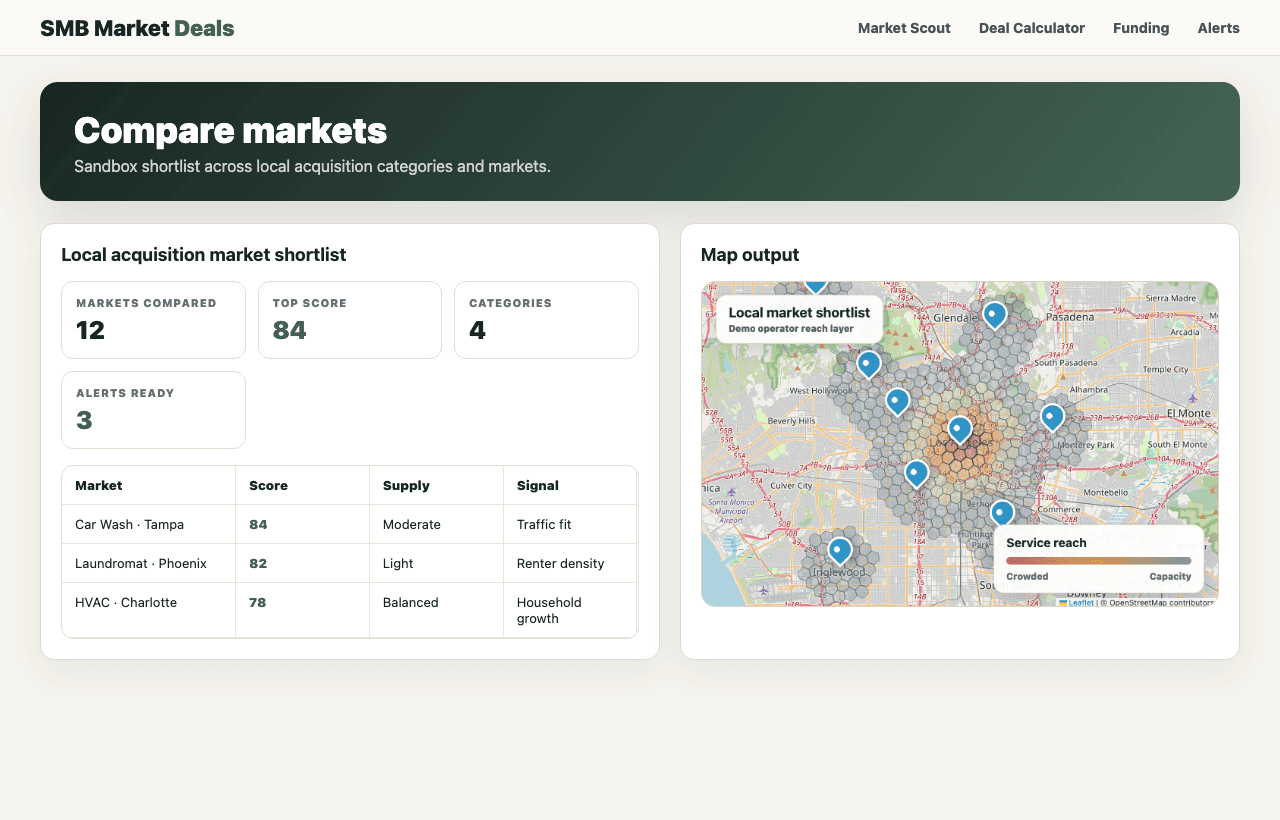
A buyer with limited cash cannot afford to chase every interesting listing. Use market fit as an early filter. For categories like laundromats, car washes, coffee shops, and local services, the trade area matters. Census ACS data and County Business Patterns can help frame demand and supply before you spend time with brokers.
This does not mean public data can pick the deal for you. It means a buyer can avoid obviously poor-fit places, then reserve diligence time for markets where the category, budget, and operating plan have a plausible match.
Watch for hidden cash needs
The deals that hurt smaller buyers are often the ones that hide cash needs outside the purchase price: payroll catch-up, inventory rebuild, broken equipment, slow receivables, lease deposits, software migrations, delayed licenses, or a seller who stops helping after closing.
Professional fees also deserve a budget line. A buyer may need an attorney, accountant, lender fees, insurance review, lease review, quality-of-earnings support, equipment inspection, environmental review, or licensing help. Smaller deals do not make those costs disappear; they make the margin for absorbing them smaller.
Collateral and personal guarantees are separate from injection. An asset-light purchase may leave the loan undersecured by business assets; ask what personal guarantees and available collateral the lender requires. Also ask who must order the valuation and what price it supports. Do not assume an informal multiple calculation replaces the required valuation.
The practical answer is to write a "cash after close" rule before looking at listings. For example, a buyer might decide that no matter how attractive the deal looks, they will not close unless a defined reserve remains outside escrow. That rule prevents the search from turning every dollar of liquidity into purchase price.
If the deal only works when everything goes perfectly, it is too tight. Lower the price, ask for more seller financing, defer seller-note payments, reduce senior debt, increase reserves, or pass.
What to do next
Write a one-page buy box before you browse listings: target cash injection, minimum reserve, acceptable industries, excluded industries, preferred local markets, required SDE support, and the transition skills you can realistically bring. Then run every opportunity through the same screen.
Frequently asked questions
Can I buy a $1 million business with $100,000?
The injection calculation may fit a $1 million total project at 10%, but only if reserves, valuation, cash flow and all other requirements fit too. A $1 million purchase plus fees and working capital is a larger total project.
Which business is best for this budget?
Favor evidence you can verify, an owner role you can perform and cash needs you can fund. Compare receivables, maintenance, inventory and employee retention across actual targets before ranking industries.
For acquisition financing requirements and the October 1, 2026 rule change, read our SBA loan guide.