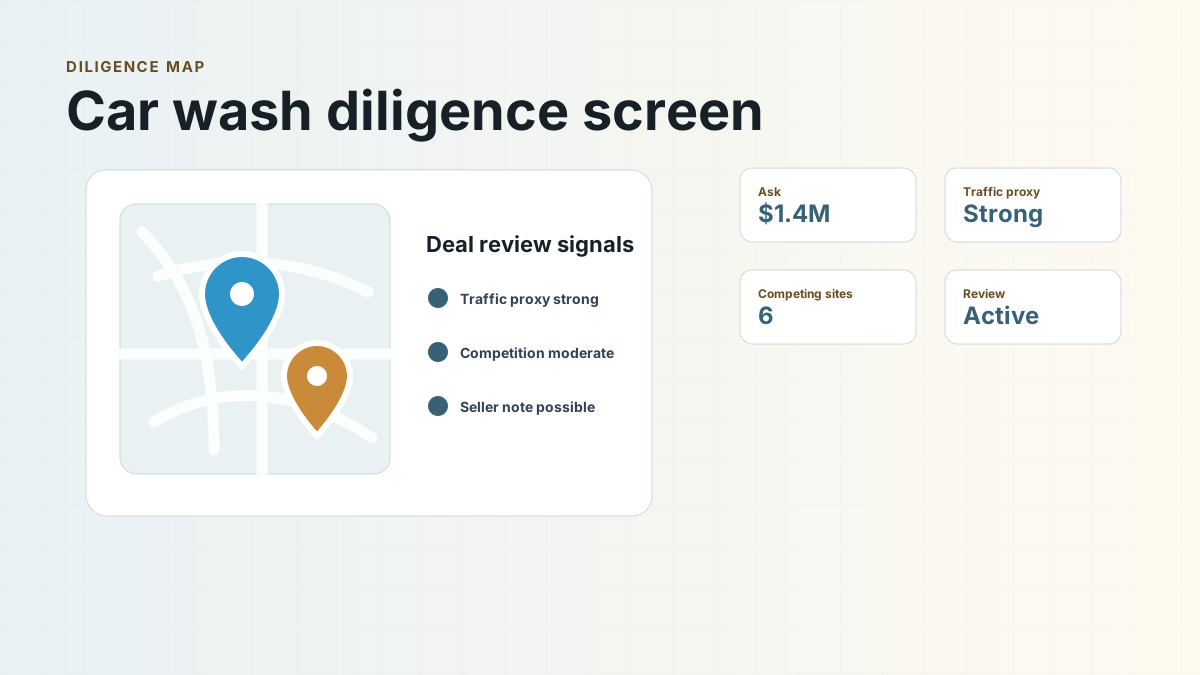
A car wash purchase combines an operating business with site, equipment and membership risks. Price the business and any real estate separately, verify recurring revenue, and fund immediate repairs before treating the asking price as the whole project. Start with the site, then test the cash flow.
Start with site control and traffic
First determine what is actually for sale. Is the buyer acquiring real estate, a long-term lease, equipment, brand, memberships, and operating entity, or only some of those assets? A car wash with weak site control can be risky even if current revenue looks strong.
Separate the operating business from the real estate in both the price allocation and financing request. A longer real-estate amortization can change debt service materially, but including a property does not automatically put the whole acquisition on a 25-year schedule. Ask the lender to calculate the permitted maturity for the actual mix of uses.
Use this before touring the site.
Car wash site diligence
Use this before touring the site.
| Question | Why it matters | Evidence |
|---|---|---|
| Real estate or lease? | Site control drives long-term value. | Deed, lease, assignment rights, renewal options. |
| Ingress and egress? | Customers need easy entry and exit. | Site visit, traffic pattern review, driveway access. |
| Visibility/signage? | Impulse and convenience matter. | Photos, sign permits, local restrictions. |
| Traffic generators? | Retail centers and commuting paths can matter. | Local observation and map review. |
Verify revenue and membership quality
Do not treat membership revenue as automatically durable. Ask for POS exports, monthly member counts, churn, refunds, discounts, failed payments, fleet/commercial accounts, prepaid liabilities, and customer concentration. Compare deposits and tax returns to the POS story. IBISWorld industry context can help frame the category, but the specific membership dashboard matters more than broad industry growth.
Reconcile monthly POS activity with deposits, tax returns and interim financial statements. Calculate active paying members, realized monthly revenue per member and monthly cancellation rate. Remove complimentary accounts and failed payments from paid membership counts. Normalize earnings for documented add-backs and replacement labor, then test all continuing and proposed debt.
Revenue proof for car wash buyers
Memberships make documentation more important, not less.
| Revenue source | What to verify | Risk |
|---|---|---|
| Single washes | POS sales, deposits, weather/seasonality. | Sales may be volatile. |
| Monthly memberships | Active members, churn, ARPU, failed payments. | Headline recurring revenue may decay after closing. |
| Fleet/commercial | Contracts, concentration, payment terms. | Accounts may depend on seller relationships. |
| Vending/detailing | Supplier costs and labor. | Ancillary revenue may not be high-margin. |
Put numbers on membership and site risk
Illustrative wash: 800 paying members at $30 per month generate $24,000 monthly membership revenue before refunds and failed payments. If monthly churn is 5%, keeping membership flat requires 40 replacement members each month. A gross signup count hides that requirement.
Membership stress with no new signups
| Point in time | Expected members | Monthly revenue at $30 |
|---|---|---|
| Start | 800 | $24,000 |
| After 1 month | 760 | $22,800 |
| After 3 months | 686 | $20,577 |
After three months, monthly revenue is about $3,423 below the starting level. The annualized run-rate gap is about $41,076, not a forecast of first-year loss. Use actual cohort renewals, cancellations and replacement-member costs to build the monthly forecast. At an assumed $45 acquisition cost, replacing 40 cancellations costs $1,800 a month before discounting.
Amortization sensitivity on the same $800,000 balance
| Illustrative term | Monthly payment at 9.5% | Annual payment |
|---|---|---|
| 10 years | $10,352 | $124,222 |
| 25 years | $6,990 | $83,875 |
For water economics, divide metered gallons and total water/sewer charges by paid washes for the same period. At an assumed $0.012 per gallon and 25,000 washes, reducing fresh-water use from 40 to 25 gallons per wash saves $4,500 before reclaim-system operating and maintenance costs. Verify meter coverage, reclaim performance and sewer billing rules before using that saving.
Inspect equipment, water, and environmental risk
A buyer should inspect tunnel or bay equipment, pumps, reclaim systems, vacuums, payment controls, chemicals, building condition, drainage, water/sewer bills, and maintenance history. Environmental, wastewater, and stormwater issues can be location-specific, so use qualified local advisors rather than generic assumptions. Industry programs such as WaterSavers are helpful background on water and environmental practices, not a substitute for local permit review.
An independent equipment inspection should produce a schedule of condition, remaining life, installed replacement cost and timing. Add immediate repairs, deferred maintenance, environmental work and working capital to total project uses. Confirm discharge approvals, reclaim-system maintenance and responsibility for remediation before treating the asking price as the full cash requirement.
Compare local competition
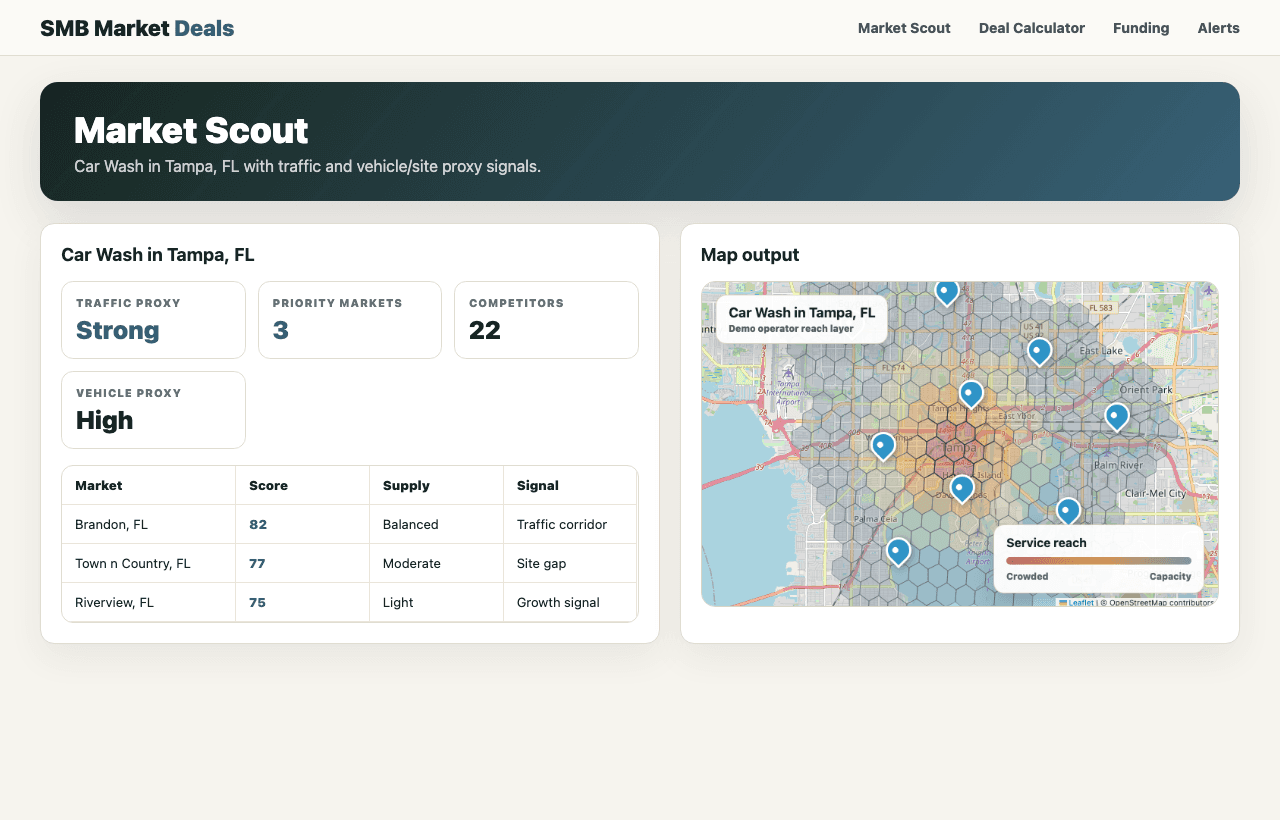
Nearby competition can pressure pricing, memberships, and volume. Compare wash quality, subscription pricing, hours, visibility, equipment, vacuums, customer reviews, and whether a newer express wash is taking share. Census establishment data and local map research can support the screen, but site visits matter.
Pay special attention to announced or under-construction sites. A trailing P&L may not reflect the impact of a new express wash opening nearby, a competitor discounting memberships, or a road project altering traffic flow. Local planning records and simple drive-time checks can be more valuable than a generic industry report.
Membership-heavy sites need an even sharper competitor review because customers can cancel or trade down. Ask whether current members joined at promotional prices, whether churn has changed after competitor openings, and whether the seller has been buying growth through discounts.
Before a binding offer, give the lender the proposed price, three years of filed business returns, current interim financials, supported add-backs, a sources-and-uses schedule, seller-note terms, immediate capital needs, buyer resume and proof of injection and remaining liquidity. Ask which valuation, collateral, lease, eligibility and closing conditions could prevent funding. Make financing, valuation, environmental clearance and acceptable property control explicit conditions with advice from counsel.
Once you know the market, price range, and deal structure you want, alerts can watch for new targets that fit the thesis.
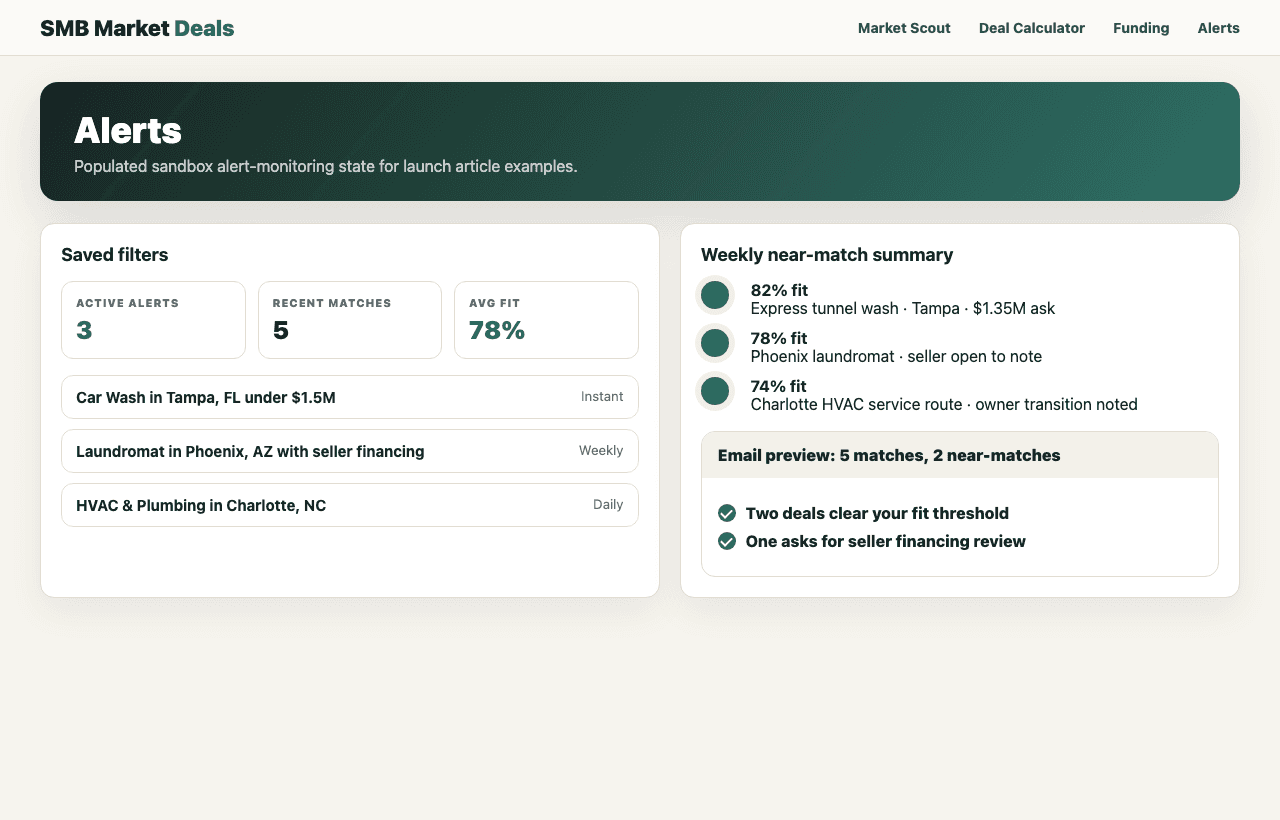
Before you set alerts, define what you would actually buy: geography, real estate requirement, maximum price, minimum verified SDE, membership quality, equipment age, capex tolerance, environmental review, seller financing need, and lender fit.
Frequently asked questions
How much does a car wash cost?
Price depends on format, owned property, verified earnings, equipment and local competition. Compare business-only transactions separately from sales including real estate, then add immediate repairs and closing uses.
Are memberships proof of profitability?
No. Calculate realized revenue after discounts, failed payments and refunds, then subtract wash costs, staffing, occupancy, marketing, debt and capital spending.
For acquisition financing requirements and the October 1, 2026 rule change, read our SBA loan guide.