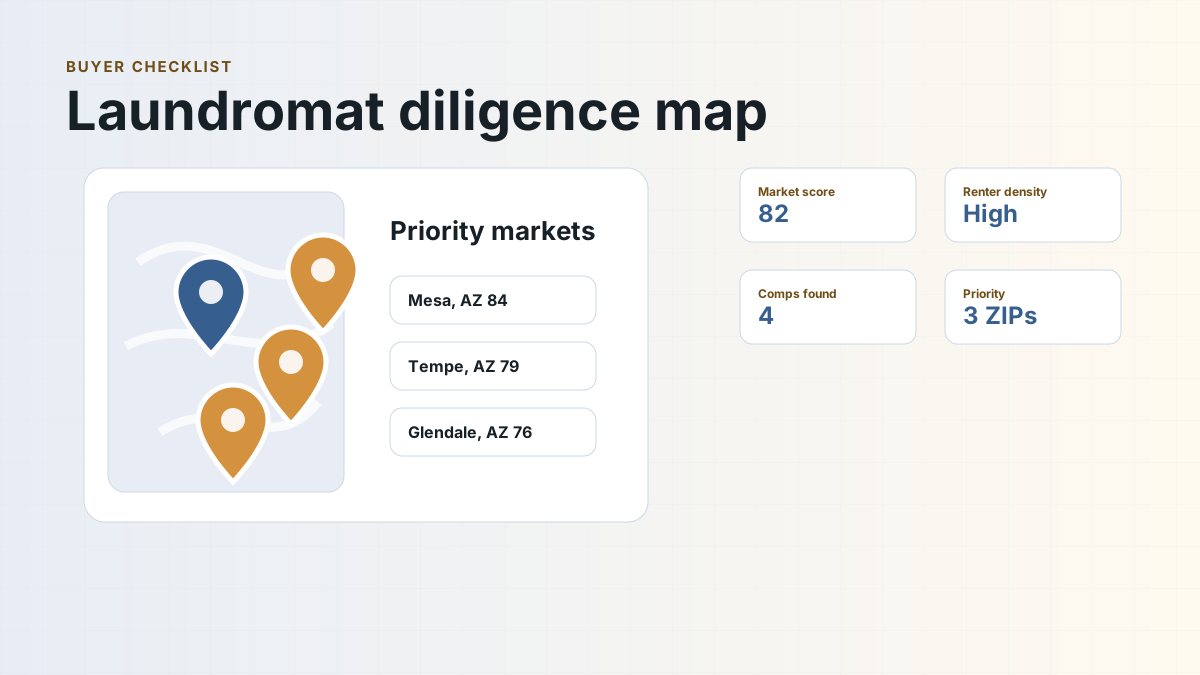
A laundromat can look simple from the outside: washers, dryers, rent, utilities, and customers who need clean clothes. The diligence is less simple. You are buying a location-dependent operating business with expensive equipment, utility exposure, lease risk, and revenue that may be harder to verify than a normal service company.
The mistake first-time buyers make is falling in love with the idea of "semi-passive" recurring demand before proving the store economics. A laundromat with old machines, weak lease control, rising utilities, or unsupported revenue can turn a reasonable-looking multiple into an expensive repair project.
An SBA lender will connect equipment, lease and transition risks to historical repayment capacity. Prepare verified cash flow, buyer liquidity, a workable equipment budget and a credible operating plan before assuming the acquisition can be financed.
Use this guide to screen a laundromat before you write an offer, call a lender, or pay for deeper diligence.
Do not pay for cash income the seller says was never reported. In his review, Adam Hoeksema identified unsupported cash-revenue claims as a recurring problem in laundromat deals he has examined. Reconcile the claim to filed returns, lender-obtained transcripts, deposits and processor records.
What you are really buying
A laundromat buyer is not only buying historical cash flow. You are buying the right to operate in a specific location, use specific equipment, keep specific customers, and continue a routine that depends on cleanliness, uptime, convenience, and trust.
That means the first screen should separate four assets: the lease, the machines, the customer base, and the operating process. If one of those assets is weak, the price needs to reflect it. If two or more are weak, the deal may need a major restructure or a pass.
The four-part laundromat screen
Strong laundromat deals usually need all four parts to hold up.
- MarketDemandRenter households, apartments, access, visibility, and competition.
- LeaseControlAssignment, renewal options, rent escalations, and landlord consent.
- MachinesCapexAge, uptime, repair history, replacement timing, and utility efficiency.
- RevenueProofCard data, coin counts, deposits, tax returns, and service mix.
Start with the market, not the machines
A laundromat's trade area should be grounded in how customers actually get there. A dense renter neighborhood with weak parking may work differently from a car-dependent suburban corridor. A store near apartments may still struggle if another cleaner, newer, easier laundromat sits closer to the customer path.
Use public and local data carefully. Census housing data can help identify renter-occupied housing patterns, and ACS subject definitions clarify what renter-occupied means. But renter share alone does not prove demand. You still need to inspect apartments, parking, bus access, visibility, safety, pricing, machine mix, and competitor quality.
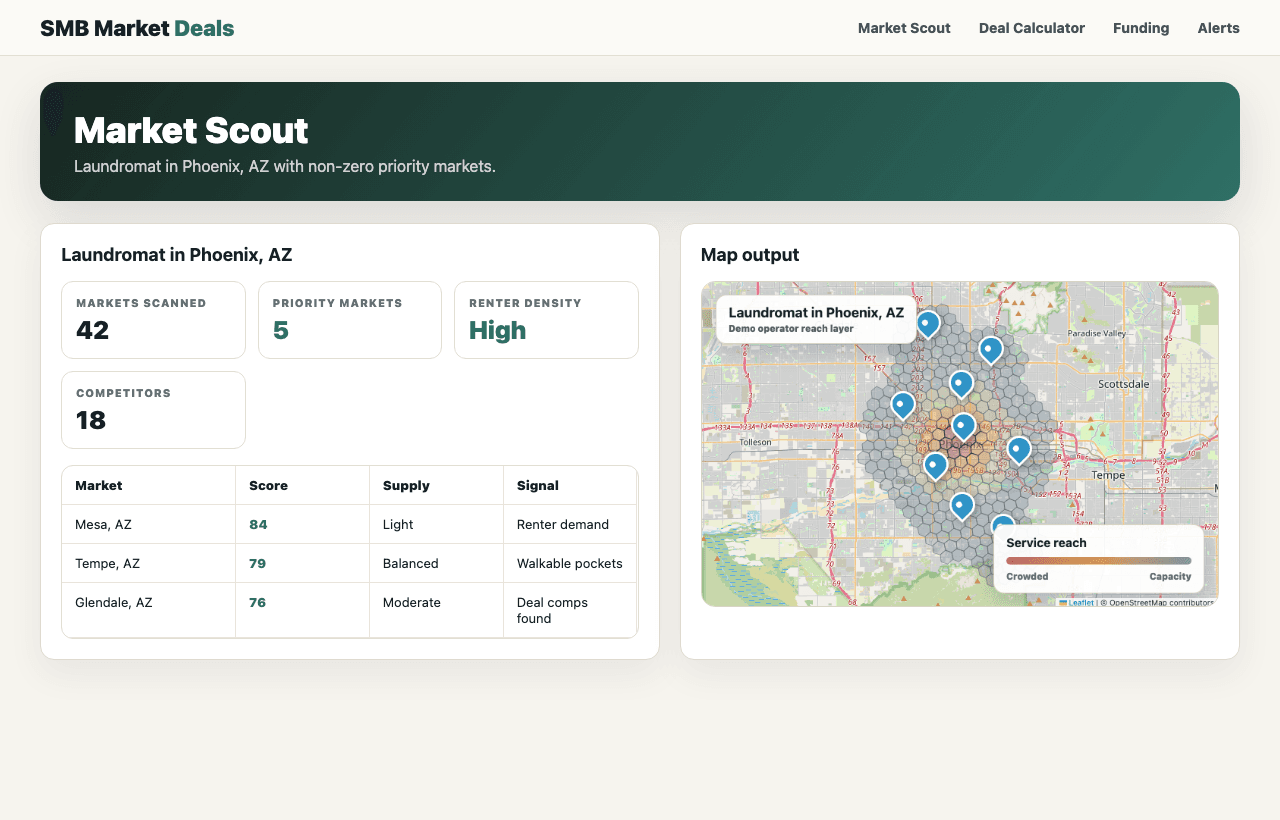
Market signals to check before touring a laundromat
Use these signals to decide whether the location deserves deeper diligence.
| Signal | Why it matters | How to verify |
|---|---|---|
| Renter density | More renter households can mean more customers without in-unit laundry. | Census/ACS housing tenure, apartment maps, local observation. |
| Competitor quality | A nearby upgraded store can pressure pricing and turns. | Visit competitors at different times; compare machines, cleanliness, pricing, and parking. |
| Access and parking | Customers carry laundry and may avoid inconvenient sites. | Observe ingress, parking turnover, sidewalks, transit stops, and nighttime safety. |
| Trade-area barriers | Highways, rail lines, rivers, and unsafe crossings can shrink the customer radius. | Map the actual driving/walking path, not just a circular radius. |
| Apartment laundry rooms | On-site machines can reduce laundromat dependence even in renter-heavy areas. | Check apartment amenities, local reviews, and property listings. |
Verify revenue before trusting SDE
Laundromat revenue can come from coin machines, card systems, wash-dry-fold, pickup and delivery, vending, ATM income, detergent sales, or other services. Each source has a different proof trail. A clean broker package should still be reconciled to hard records.
Ask for card processor exports, coin collection logs, bank deposits, tax returns, utility bills, POS reports, wash-dry-fold order history, payroll records, and any third-party pickup/delivery platform data. If coin revenue is material, ask how collections are counted, deposited, and reconciled.
Start with filed returns and transcripts, then reconcile deposits, card exports, POS activity, coin controls and utilities. Treat revenue above reported amounts as unsupported unless properly reported and independently verified to the lender's satisfaction.
Revenue proof should answer three questions
- Are reported sales consistent with bank deposits, tax returns, card reports, and coin collection practices?
- Do water, gas, and electric bills make sense relative to claimed washer/dryer usage?
- Which revenue is self-service and recurring versus labor-dependent or owner-driven?
Inspect machine age and capex risk
Machines are the most visible part of the store, but buyers still underwrite them too casually. A laundromat with older machines may have attractive current cash flow only because the seller has delayed replacement. That deferred capex belongs in your purchase math.
Build a machine schedule. For each washer and dryer, record brand, capacity, model, serial number if available, install date, service history, parts availability, payment system, turns per day if tracked, and whether it is leased, financed, or owned. Then ask a distributor or technician what replacement and repair reality looks like for that exact mix.
Equipment diligence table
A buyer should be able to complete this before final pricing.
| Question | Why it matters | Evidence to request |
|---|---|---|
| How old are the machines? | Age affects replacement timing, uptime, and lender comfort. | Install invoices, serial numbers, distributor records, seller schedule. |
| Which machines are down or unreliable? | Downtime reduces revenue and customer trust. | Repair logs, technician invoices, in-store observation. |
| Are parts easy to source? | Obsolete machines can turn small repairs into replacement decisions. | Technician feedback, distributor confirmation. |
| Are controls coin, card, app, or hybrid? | Payment systems affect revenue proof and customer behavior. | Processor reports, hardware contracts, software subscriptions. |
| What replacement is coming soon? | Deferred capex changes the real purchase price. | Capex schedule, distributor quote, lender reserve discussion. |
Price the old machines before you negotiate
Illustrative equipment replacement schedule
| Asset group | Quantity | Installed cost each | Planned timing | Total |
|---|---|---|---|---|
| Large washers | 4 | $12,000 | First 12 months | $48,000 |
| Dryer pockets | 6 | $4,000 | Months 12–24 | $24,000 |
| Payment system | 1 | $8,000 | At transition | $8,000 |
The first-year equipment requirement is $56,000 and the two-year total is $80,000. A $350,000 asking price therefore becomes $430,000 before working capital and fees if the whole schedule is necessary. Do not add an annual reserve for these same replacements on top of this cash schedule without reconciling the two.
Utility cross-check: suppose paid washer starts rise from 4,000 to 4,400 while metered monthly water rises from 160,000 to 220,000 gallons. Starts increase 10%, but water increases 37.5%; gallons per start rises from 40 to 50. Investigate machine mix, leak history, wash-dry-fold production and other meter users. This is an illustrative anomaly, not proof of concealed revenue.
For local context, the stored 2022 ACS five-year estimate for Arizona ZCTA 85008 is 16,447 renter households out of 23,098 occupied households, or 71.2%. That calculation supports a renter-demand screen only. It does not identify households lacking laundry or prove that this trade area needs another store. The local market comparison guide explains the same calculation across four areas.
Site and infrastructure diligence
| Check | Evidence |
|---|---|
| Permitted use and occupancy | Zoning and occupancy confirmation for the intended operation |
| Water, sewer, gas and electric capacity | Utility capacity and upgrade quotes |
| Drainage, venting and flood exposure | Inspection, maps and required remediation |
| Rates and environmental obligations | Published tariffs, planned increases, permits and local review |
Model utilities and lease control
Utilities are not background noise in a laundromat. Water, sewer, gas, and electric costs are core operating inputs. ENERGY STAR notes that certified commercial clothes washers are, on average, more energy efficient and use substantially less water than standard models, which reinforces why equipment mix can affect operating cost. EIA electricity price data also shows that electricity prices vary by customer type and location, so a buyer should use local bills rather than national assumptions.
Ask for at least 12 months of utility bills, and preferably 24. Compare usage and cost against reported revenue, machine turns, seasonal patterns, rate changes, and any known leaks or repairs. If the seller claims revenue growth but utility usage is flat or falling, ask why.
The lease can be just as important as the utility bill. Confirm assignment rights, landlord consent, renewal options, rent escalations, CAM charges, exclusive-use language, signage, maintenance obligations, plumbing responsibility, HVAC responsibility, and whether the landlord can disrupt operations for building work.
For a leased site, ask the lender to review the remaining term, renewal options controlled by the buyer, assignment and landlord waiver before you sign. Plan for site control through the loan term, commonly ten years for a business-only acquisition. A renewal that needs fresh landlord approval is not the same as a buyer-controlled option.
Compare pickup, drop-off, and wash-dry-fold upside
Wash-dry-fold and pickup/delivery can be real growth levers, but they are not free upside. They add labor, scheduling, quality control, customer-service expectations, insurance questions, route economics, and sometimes software or marketing costs.
Separate proven revenue from imagined upside. If the seller already runs wash-dry-fold profitably, review order history, labor hours, pricing, rewash/refund issues, commercial accounts, and customer concentration. If the seller does not run it, treat it as a post-close project, not part of today's valuation.
Do not capitalize an unlaunched service line as current earnings. Model orders, price per pound, direct labor, route time, platform fees, refunds, marketing and ramp timing separately. Stress those projections below the seller's case; they do not establish historical coverage.
Service mix diligence
Do not value every dollar of laundromat revenue the same way.
| Revenue type | Diligence focus | Risk question |
|---|---|---|
| Self-service wash/dry | Machine turns, pricing, payment data, utility consistency. | Are customers using the store because of location and quality or because prices are temporarily low? |
| Wash-dry-fold | Labor, process, order history, refunds, staffing. | Can this continue without the seller personally managing it? |
| Pickup/delivery | Route density, app/platform costs, driver labor, repeat orders. | Does route time erase the margin? |
| Vending/ancillary | Supplier costs, shrinkage, machine ownership. | Is this meaningful profit or just convenience revenue? |
| Commercial accounts | Contracts, concentration, pricing, payment terms. | Would the account stay after an ownership change? |
Price the deal after the risk review
Only after market, revenue, equipment, lease, and utilities are understood should you decide what the laundromat is worth to you. The broker's multiple may be a starting point, but your offer should reflect verified SDE, upcoming capex, lease runway, financing structure, buyer salary, and working capital.
If the store has old machines, a short lease, unsupported cash revenue, or high utility exposure, the right answer may be a lower price, seller financing, escrow for repairs, a lease extension contingency, or no offer. A laundromat can be a good business and still be a bad acquisition at the wrong structure
What to do before making an offer
Before making an offer, write a short investment memo for yourself. Include the trade area, competitor map, revenue proof, equipment schedule, utility review, lease summary, required capex, financing plan, and the first 90 days of operational work. If you cannot explain those items clearly, you are not ready to price the deal.
The best laundromat buyers are boring in the right way. They count machines, read leases, reconcile deposits, call technicians, inspect utility bills, and visit competitors. That is how you avoid overpaying for old machines wrapped in a good story.
Frequently asked questions
How much does it cost to buy a laundromat?
Budget the business price plus immediate equipment, transaction costs and opening working capital, then separate retained personal cash. In the example, $350,000 becomes $430,000 after two-year equipment needs alone.
Are old machines always a reason to pass?
No. Document condition, parts availability and installed replacement costs. A lower price and funded replacement plan may work; an unsupported estimate of remaining life is not enough.
For acquisition financing requirements and the October 1, 2026 rule change, read our SBA loan guide.