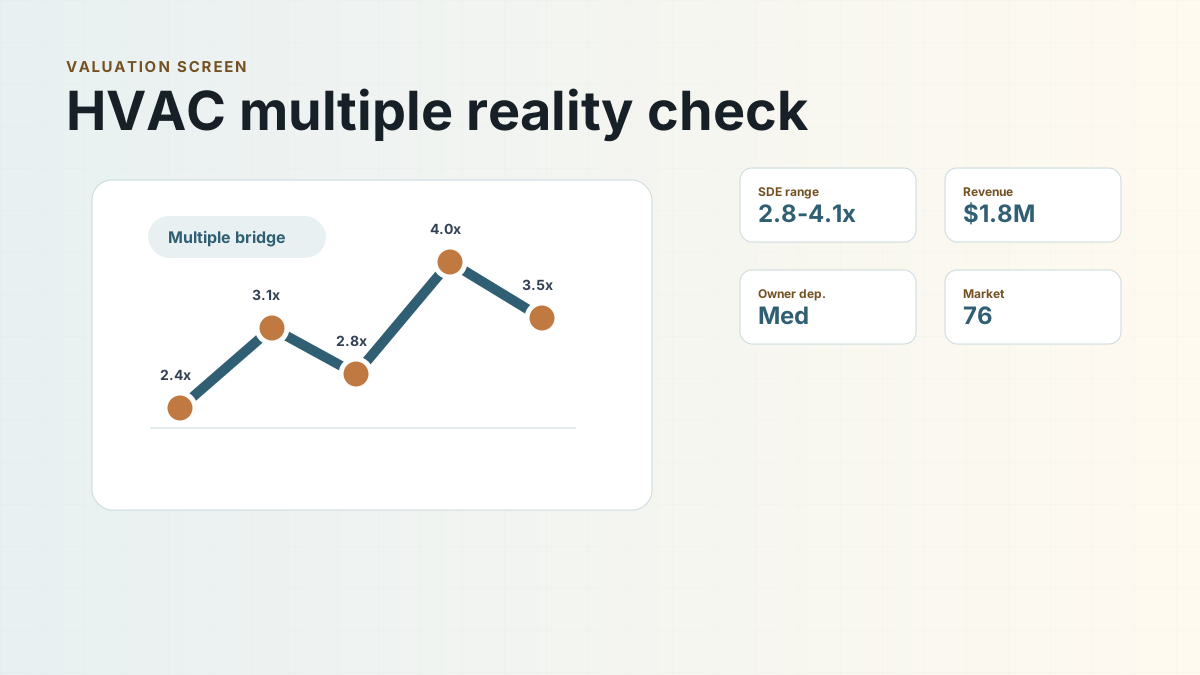
BizBuySell reports a 2.83x average earnings multiple for HVAC sales in its Q3 2021–Q2 2026 dataset. Use that as context, then verify the earnings underneath your target's multiple. Technician retention, agreements, callbacks and the seller's operating role can change transferable cash flow substantially.
Test the multiple against job history, agreement renewals, gross margin by service line, technician capacity, callbacks and customer concentration. Identify which results depend on the seller continuing to sell, schedule or supervise.
For a financed acquisition, ask the lender which coverage requirement applies and whether any seller note receives equity credit. The headline SDE multiple does not establish loan eligibility.
An observed HVAC multiple and a normalization example
BizBuySell's Q3 2021–Q2 2026 reported transactions show HVAC at an average 2.83x earnings multiple and a $750,000 median sale price. This is Main Street transaction context, not a private-equity EBITDA benchmark. Averages and medians describe different statistics and should not be divided to infer a typical company's earnings.
Why verified SDE matters more than the headline multiple
| Calculation | Seller case | Verified case |
|---|---|---|
| SDE | $320,000 | $280,000 |
| Price | $900,000 | $900,000 |
| Price / SDE | 2.81x | 3.21x |
| Price at 2.83x SDE | $905,600 | $792,400 |
That $40,000 earnings adjustment changes the price indication by $113,200 at the same multiple. Now review capacity. If two technicians leave and 160 billable hours per month disappear at an assumed $110 contribution per billable hour, monthly contribution drops $17,600 before recruiting and training. Use actual billed hours and contribution after variable costs, not the posted hourly customer rate.
Maintenance agreement cohort: illustrative review
| Measure | Calculation | Result |
|---|---|---|
| Opening active agreements | Starting cohort | 600 |
| Renewals from that cohort | 510 / 600 | 85% retention |
| New agreements | Additional customers | 120 |
| Closing agreements | 510 + 120 | 630 |
Ask for cohort renewal exports, realized agreement revenue, included visits, technician hours and repair conversions. A growing agreement count can be unprofitable if pricing does not cover promised visits. Normalize seasonality using comparable months and examine the first heating or cooling peak after closing.
Why headline multiples are incomplete
Start with three years of returns and financial statements, plus current interim results. Verify each add-back independently. Calculate transferable earnings after necessary replacement compensation, then calculate debt service separately. Routine tools, software and payroll already recorded as expenses should not be deducted again.
Separate revenue quality before applying a multiple
Start by splitting revenue into maintenance agreements, residential replacement, commercial service, emergency repair, new construction, warranty work, and one-time project revenue. ACCA guidance on maintenance agreements explains why recurring agreements can help contractors fill slower periods and plan work, while replacement spikes can make trailing SDE look stronger than the next owner can repeat.
HVAC revenue quality screen
Use this before accepting the broker multiple.
| Revenue stream | Diligence question | Valuation implication |
|---|---|---|
| Maintenance agreements | Are agreements transferable, priced correctly, and actively renewed? | More durable if churn and margins are documented. |
| Replacement installs | Were recent jobs normal demand or weather/one-time spikes? | High-margin but may be less predictable. |
| Emergency repair | Who answers phones and dispatches after hours? | Process quality affects continuity. |
| Commercial accounts | Are contracts written and diversified? | Customer concentration can reduce value. |
| New construction | Is revenue tied to a builder relationship? | May be cyclical or relationship-dependent. |
Technician bench and owner dependence
BLS describes HVAC mechanics and installers as workers who install, maintain, and repair heating, cooling, ventilation, and refrigeration systems. For buyers, that labor reality matters because an HVAC company is often constrained by technician capacity, licensing, training, callback rates, and recruiting.
Ask who can sell, diagnose, quote, install, service, and supervise without the owner. If the seller is the top salesperson, estimator, senior technician, and customer relationship manager, a headline multiple based on SDE may overstate transferable earnings.
Technician bench diligence
This is where many HVAC deals move from attractive to fragile.
| Area | Evidence | Risk if weak |
|---|---|---|
| Technician retention | Payroll history, tenure list, compensation plan. | Crew leaves after closing or demands reset economics. |
| Licensing and supervision | License holder, permits, compliance records. | Buyer cannot operate or pull permits smoothly. |
| Callbacks and warranty work | Service records, callback rates, warranty reserve. | Reported margin may be overstated. |
| Dispatch and CRM | Job history, close rates, follow-up process. | Revenue depends on seller memory instead of systems. |
Market density and service area
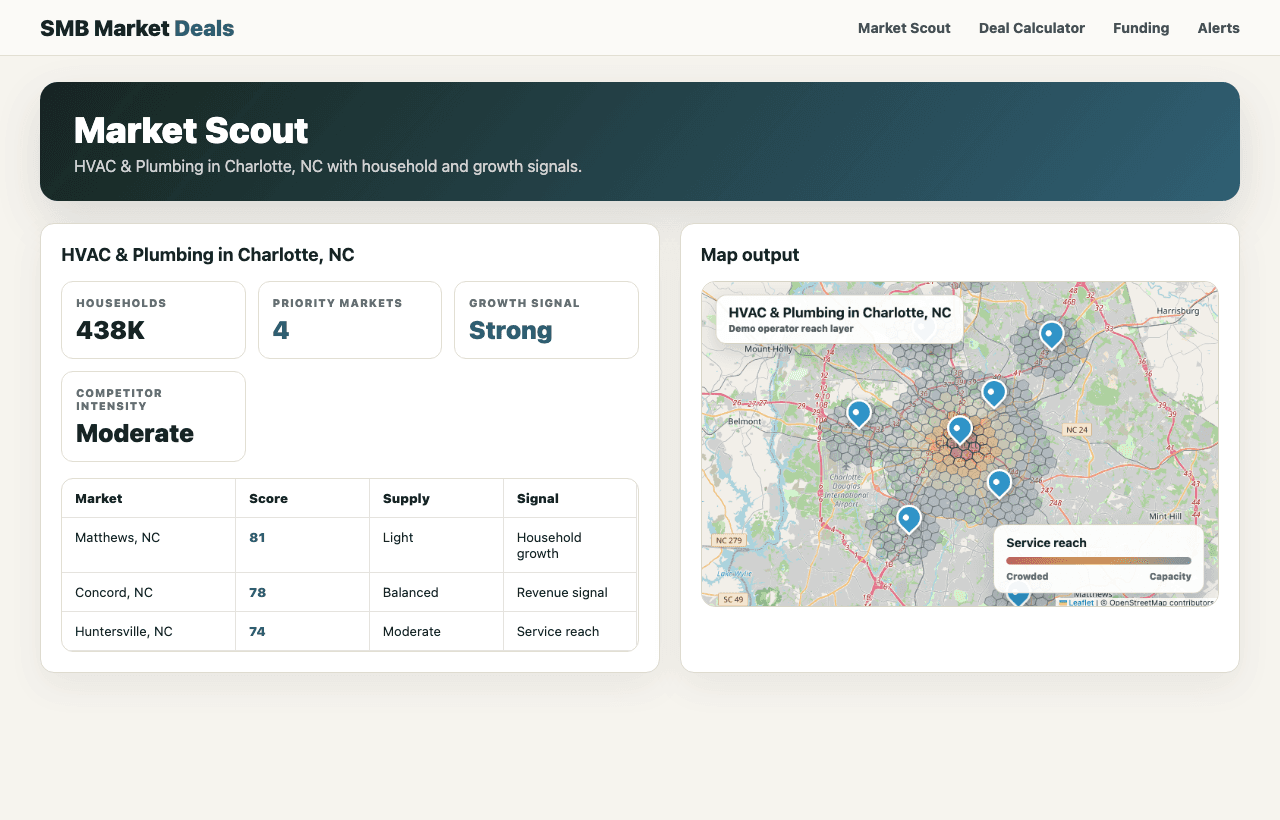
HVAC is not usually a one-block retail trade area. Households, housing age, income, weather, construction mix, and competitor density all matter across a broader service radius. Use County Business Patterns context and local competitor research to decide whether the growth story is plausible.
A buyer should also compare service-area promises with actual dispatch economics. A company may say it serves an entire metro, but drive time, technician location, emergency response expectations, and local permitting can shrink the practical market.
Debt service and transition risk
Test verified operating cash flow against senior debt, paying seller debt and other continuing obligations. Budget incremental vehicle replacements and transition costs separately from expenses already in the P&L. Model the loss of seller-led sales or technician departures before assuming perfect continuity.
Use 1.25x as an illustrative coverage target when testing this deal, then confirm the applicable rule and lender policy. At $160,000 of annual debt service, that target requires $200,000 of accepted cash flow. A seller's $220,000 SDE with $40,000 of rejected add-backs leaves $180,000 and only 1.13x coverage.
That transition model should include the first cooling or heating season after closing. Seasonal demand can hide operational weakness, and a buyer who closes right before peak season may inherit staffing, dispatch, warranty, and customer-service pressure before they understand the business.
If the seller says growth is easy, ask which constraint has prevented it so far. In HVAC, the answer is often technician capacity, phone coverage, sales process, fleet, working capital, or owner attention. Each constraint has a cost that should be reflected in either price, structure, or post-close plan.
What to check before making an offer
Do not offer on an HVAC business because the multiple sounds market. Offer only after you can explain transferable SDE, technician bench, customer mix, local demand, recurring revenue, owner dependence, working capital, and lender readiness. If the seller cannot support those items, the multiple should move down or the structure should change.
Frequently asked questions
What multiple do HVAC businesses sell for?
The cited reported-sales average is 2.83x earnings for the stated five-year window. It is a reference point; verify company size, owner role, revenue quality and included assets before applying it.
Do maintenance agreements deserve a premium?
Only when retention, pricing, service obligations and contribution support repeatable earnings. Agreement counts alone do not establish that value.
For acquisition financing requirements and the October 1, 2026 rule change, read our SBA loan guide.