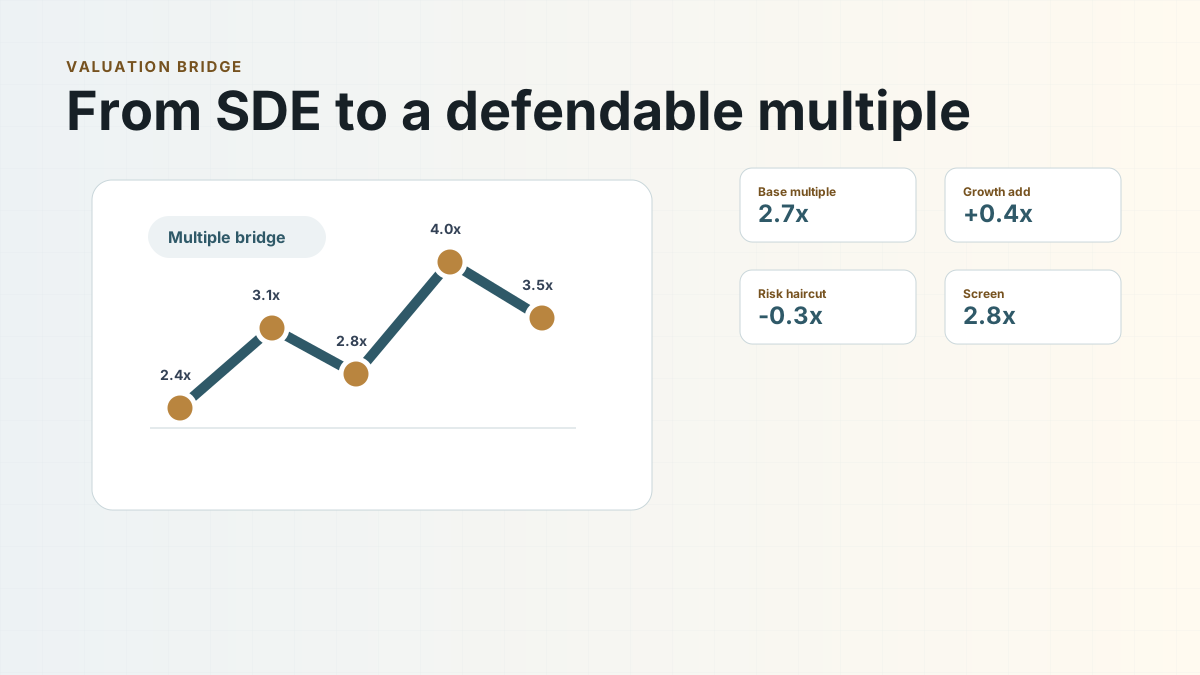
A small business valuation multiple is a shortcut. It is not the valuation. Buyers usually hear a business is listed at "three times SDE" and start debating whether that multiple is fair. The better first question is whether the SDE is real, transferable, and enough to support the buyer's financing and salary. The Business Reference Guide from Business Brokerage Press is one example of a professional reference buyers may encounter when researching rules of thumb and SDE-based valuation context.
Published multiple data can help orient a buyer, but it should not replace deal-specific diligence. IBBA and M&A Source Market Pulse reports distinguish between smaller Main Street transactions and lower-middle-market deals, which is exactly why buyers should avoid mixing small-business SDE multiples with larger-company EBITDA multiples.
Start with transferable earnings
A buyer is not buying the seller's past lifestyle. The buyer is purchasing the future cash flow that can be transferred after closing. If the seller personally drives sales, holds licenses, maintains key relationships, or works 70 hours a week without market-rate replacement cost, SDE may overstate what the buyer gets. Exit Planning Institute frames transferable value in terms of human, structural, customer, and social capital, which is a useful lens for buyer diligence, too.
Normalize SDE carefully
SDE usually starts with profit and adds back owner compensation, discretionary expenses, interest, depreciation, amortization, and non-recurring items. Each add-back needs evidence. Some seller expenses are legitimate add-backs. Others are simply operating costs that will continue after closing.
Routine repairs are operating expenses, not automatic add-backs. An exceptional one-time event needs evidence that it will not recur; deferred maintenance often means the buyer needs more cash, not that the business earned more.
Add-back review table
Label each add-back before accepting normalized SDE.
| Add-back type | Often reasonable when | Buyer caution |
|---|---|---|
| Owner salary | The buyer will replace the owner and salary is already counted correctly. | A buyer still needs salary or replacement management cost. |
| Personal auto/travel | Clearly personal and not needed for the business. | Some vehicle/travel cost may continue for sales or operations. |
| Exceptional one-time costs | Documented and demonstrably nonrecurring | Routine repairs and deferred maintenance are not automatic add-backs. |
| Family payroll | Person did not work in the business. | If family member performed real work, replacement labor is needed. |
| Rent adjustment | Market rent is clearly different from current rent. | Lease renewal may reset economics. |
Published multiples and a buyer adjustment
BizBuySell reports these average earnings multiples for transactions reported from Q3 2021 through Q2 2026: cleaning businesses 2.25x, HVAC 2.83x and laundromats 3.70x. These are reported sale observations, not asking-price averages or a valuation of your target.
One price, three earnings definitions
| Earnings basis | Annual earnings | Multiple at $750,000 price |
|---|---|---|
| Seller-presented SDE | $300,000 | 2.50x |
| Remove $30,000 unsupported add-backs | $270,000 | 2.78x |
| Then fund $70,000 separate manager | $200,000 | 3.75x |
At the original 2.50x arithmetic, verified SDE of $270,000 indicates $675,000, a $75,000 difference from the asking price. That is a sensitivity calculation, not an appraisal. Next test whether the manager is actually necessary. If the buyer performs that role, deducting both a manager and a full owner-compensation allowance would overstate costs.
Add-back evidence that changes the offer
| Claim | Required evidence | Decision |
|---|---|---|
| $18,000 personal travel | Invoices, purpose and proof it will cease | Accept only the portion that is not needed for sales |
| $12,000 repairs | Three-year maintenance pattern and technician findings | Keep recurring upkeep as an expense |
| $30,000 family payroll | Hours, duties and replacement plan | Add back only work that will not need replacing |
The Business Reference Guide is published by Business Brokerage Press. Use it and transaction reports to identify comparable industries and size bands. Then reconcile assets, inventory, real estate, working capital and assumed liabilities included in each comparison; two identical multiples can refer to very different packages.
A multiple is a shorthand, not a verdict
The same multiple can be cheap or expensive depending on risk. A business with clean records, recurring revenue, strong staff, low capex, and low owner dependence can justify a stronger valuation than a business with unsupported cash sales, customer concentration, immediate repairs, and a short lease.
Buyer valuation screen: Value depends on verified SDE × risk-adjusted multiple, then adjusted for capex, working capital, and structure. Do not let a headline multiple hide near-term cash needs or transition risk.
Run buyer cash-flow math
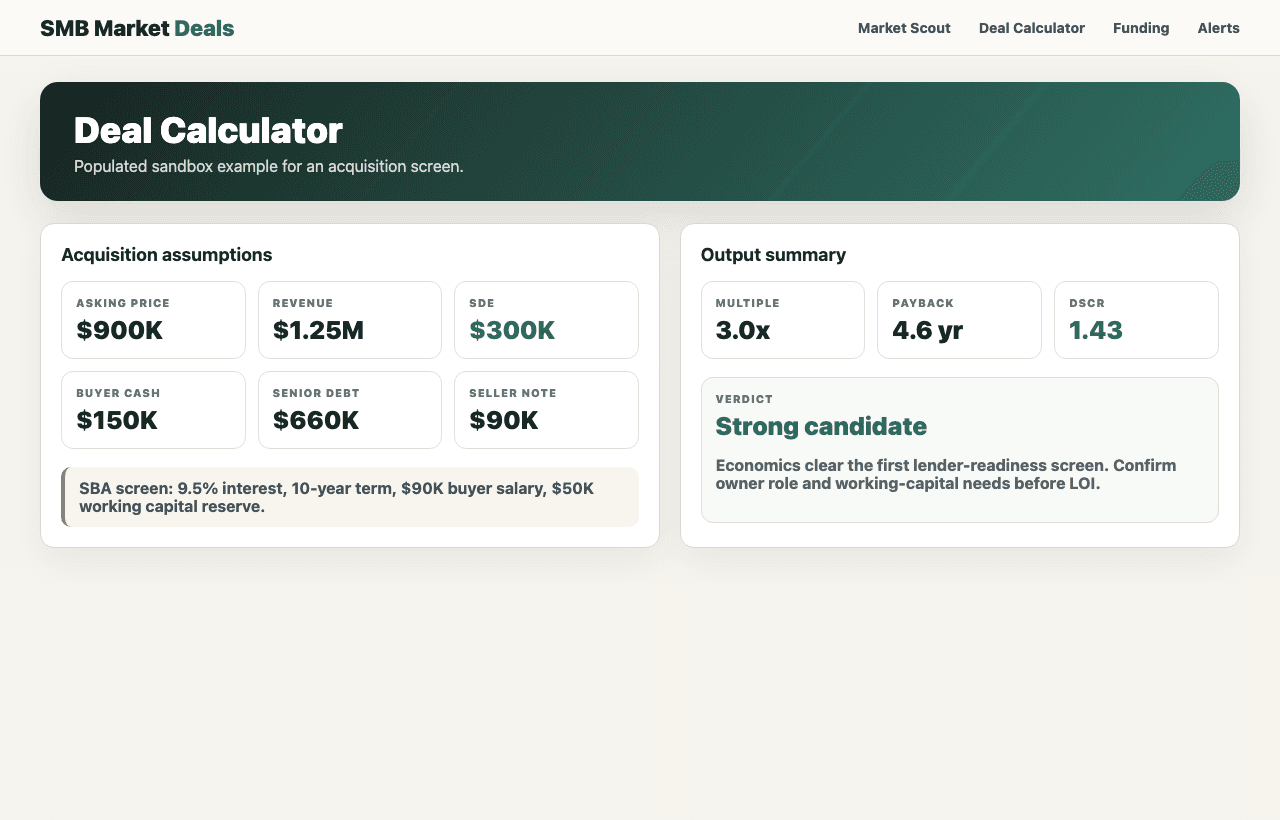
For an SBA purchase, price and financing are reviewed together. The lender evaluates supported valuation, verified injection, seller debt, working capital, closing costs and other project uses. A price above supported value can require additional equity or a revised structure; increasing the requested loan is not an automatic solution.
Adjust for risk before making an offer
Translate diligence findings into a lower fixed price, lender-approved seller financing, repair escrow, inventory adjustment, lease condition or documented training period. SBA seller earnouts are prohibited. Do not assume a contingent or forgivable note is an acceptable substitute: ask lender and counsel to approve the exact provision before it enters an LOI.
Match the condition to the risk. Customer handoff needs documented transition responsibilities. Equipment problems need inspection and a priced repair plan. Weak lender debt-service coverage may require less debt, more equity or a lower price. Keep proposed holdbacks and adjustments subject to lender and legal review.
Do not let a seller or broker force every diligence concern into a single multiple debate. Serious buyers translate each concern into one of four places: price, terms, conditions, or walk-away criteria.
If you cannot verify earnings, transfer customer relationships, keep key employees, or finance the deal with enough cushion, the right valuation may be no offer.
Before a binding offer, give the lender the proposed price, three years of filed business returns, current interim financials, supported add-backs, a sources-and-uses schedule, seller-note terms, immediate capital needs, buyer resume and proof of injection and remaining liquidity. Ask which valuation, collateral, lease, eligibility and closing conditions could prevent funding.
Frequently asked questions
Is three times SDE a fair price?
It depends on the verified earnings, included assets, owner role and financing. A quoted 2.50x became 3.75x of manager-adjusted cash flow in the example without any price change.
Can I use an EBITDA multiple on SDE?
No. Reconcile owner compensation and other adjustments first. Applying a larger-company EBITDA multiple to an owner-operated SDE figure mixes definitions and can materially overstate value.
For acquisition financing requirements and the October 1, 2026 rule change, read our SBA loan guide.