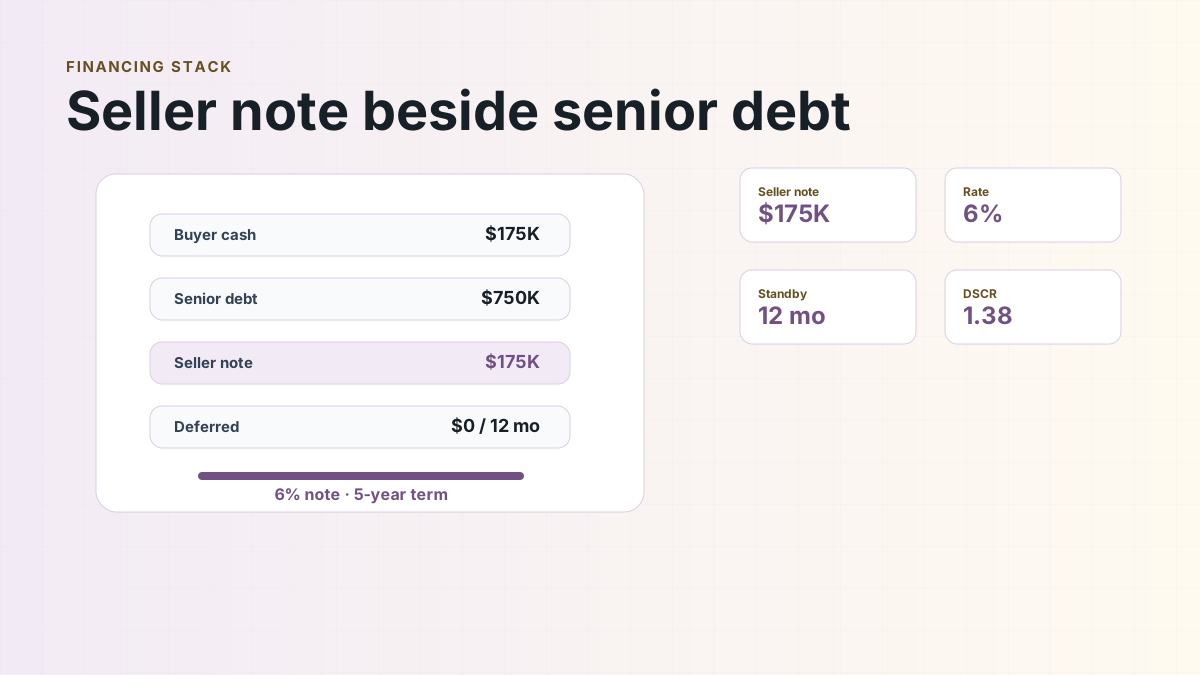
Seller financing can make a small business acquisition more realistic, but it can also make a weak structure look better than it is. A seller note is not free money. It is debt, alignment, negotiation leverage, and transition risk sharing rolled into one document. SBA-related seller-note treatment can change with program rules, so buyers should verify current requirements in SOP 50 10 and with their lender before relying on any structure.
What seller financing does
Seller financing means the seller receives part of the purchase price later through a promissory note. Properly structured, it can reduce the bank loan, preserve buyer liquidity and keep the seller financially exposed to a successful transition. It does not automatically reduce the required equity injection: that depends on lender approval of the note and its standby terms.
Terms that matter more than the note amount
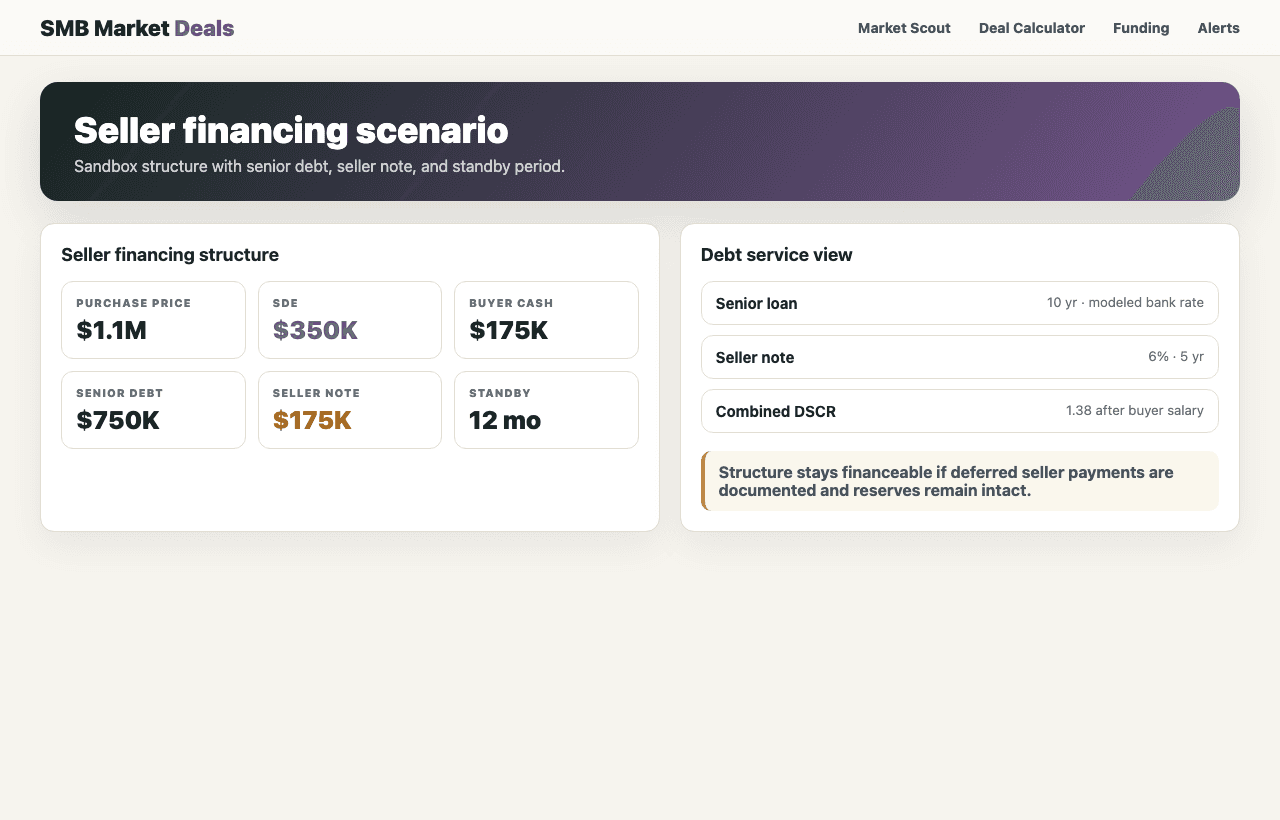
A $200,000 seller note can mean very different things depending on term, interest rate, amortization, payment start date, balloon, standby requirements, collateral, default rights, and subordination to senior debt. Buyers should model the exact payment schedule, not just the headline note size. SBA lenders may also apply specific standby or subordination expectations; NAGGL program notices are useful context, but lender counsel should confirm the actual loan structure.
Seller note terms to screen
These terms change both lender readiness and buyer risk.
| Term | Buyer question | Why it matters |
|---|---|---|
| Payment start | Do payments begin immediately or after a standby period? | Year-one cash flow can change materially. |
| Amortization | Is the note amortizing, interest-only, or balloon-heavy? | Cash drain and refinance risk differ. |
| Subordination | Does senior lender require the seller to sit behind the bank? | Can affect lender approval and seller negotiation. |
| Security | What collateral or remedies does the seller have? | Affects downside risk if the business underperforms. |
| Transition obligations | Is seller help tied to the note or documented separately? | Training and handoff should be explicit. |
How seller financing changes debt service
Calculate estimated cash flow three ways: bank debt alone, bank debt plus a paying seller note, and bank debt plus a deferred note. Lower bank exposure may help approval, but total scheduled debt service determines whether early cash flow actually improves.
A $200,000 seller note: three payment schedules
Illustrative fixed-rate example: $1 million purchase, $100,000 buyer cash, $700,000 bank debt at 9.5% over ten years, and a $200,000 seller note at 6% over five years. Assume $180,000 of verified annual business cash flow. Rates are modeling assumptions, not current offers.
The payment schedule changes coverage
| Structure | Annual bank payments | Annual seller payments | Total debt service | DSCR |
|---|---|---|---|---|
| Seller note pays immediately | $108,694 | $46,399 | $155,093 | 1.16x |
| Seller note deferred: initial period | $108,694 | $0 | $108,694 | 1.66x |
| After two years: interest capitalized, then 5-year repayment | $108,694 | $52,299 | $160,993 | 1.12x |
Write the payment schedule into the term sheet: original principal, interest accrual, payment start, amortization after deferral and any balloon. Deferral improves early cash flow but can increase later payments. Full standby for equity credit is a different structure; accrued interest and eventual repayment still need a plan.
Which SBA rules apply to your closing?
Checked September 15, 2026: SOP 50 10 8 is in force; SBA lists version 8.1 as effective October 1, 2026. Ask the lender which version applies to your loan number and transaction type. The change can affect an acquisition already under negotiation.
Selected acquisition rules by effective date
| Item | Version 8 | Version 8.1 from October 1 |
|---|---|---|
| New-owner acquisition injection | At least 10% of total project costs | Initial acquisition: 10% |
| Seller debt as injection | Full standby for loan life; at most half of required injection | Full-standby seller debt shares a half-injection cap with other limited sources |
| Repayment coverage | Standard 7(a): at least 1.15x business; 1.0x global | Initial acquisition: 1.25x historical or justified adjusted coverage; 1.0x global |
Under the 10% rule, a $1 million project requires $100,000 injection. Up to $50,000 may come from a qualifying standby seller note; the remaining $50,000 must come from acceptable sources. This does not fund personal reserves or erase the seller debt. The lender must approve the documentation and complete structure. Read the current SOP 50 10 before negotiating those terms.
Lender readiness and SBA context
SBA 7(a) financing can fund eligible ownership changes. The lender must still evaluate purchase price, buyer injection, seller financing, valuation, collateral and repayment capacity under SOP 50 10. Submit the seller note with the financing package so the bank can review the entire transaction.
How to use seller financing in an offer
Use seller financing to solve specific deal problems. If transition risk is high, ask for more seller financing and stronger training obligations. If senior debt is too high, ask for a seller note that reduces bank leverage. If year-one cash flow is tight, discuss deferred payments or standby terms where appropriate.
The offer should describe the business reason for the note. A note tied to transition support sends a different message than a note used only because the buyer lacks cash. A lender, attorney, and seller will all want to understand how the note interacts with security, default rights, senior debt, and post-close operating needs.
Get the lender's written view of proposed payment, subordination and standby terms before finalizing the LOI. A subordinated note sits behind senior debt in priority; an amortizing note requires scheduled principal payments; a full-standby note prevents payments during its specified term. These are different features, and a note can have more than one.
Buyers should also model what happens when the standby or deferral period ends. A structure that looks comfortable in year one can become tight in year three if seller-note payments begin before revenue growth, margin improvement, or debt paydown has actually happened.
The right seller note is not the largest one. It is the one that creates enough alignment, preserves enough cash flow, and fits the lender's structure while giving both buyer and seller a reason to make the transition work.
Frequently asked questions
Does a seller note improve DSCR?
Only if the change lowers the debt payments used in the calculation. Reducing bank principal while adding an expensive short-term seller note can reduce combined coverage.
Is there a normal seller-financed percentage?
There is no percentage that makes every acquisition work. Negotiate from the price gap, buyer liquidity, available bank debt and supportable payment schedule.